Reviving Nigeria's Fibre, Textile and Apparel Sector
Under the leadership of the Honourable Minister of State for Industry, the Federal Ministry of Industry, Trade and Investment is implementing the National Industrial Transformation Programme to position the fibre-to-fashion value chain as a driver of jobs, exports, and industrial growth through targeted policies, institutional coordination, and catalytic projects.
Why the FTA Sector Matters
Every garment begins as fibre. In Nigeria, it often starts as cotton planted by farmers in the North and the South-West. The cotton then moves through ginneries, textile mills, and garment factories before ending up as clothing. The Fibre, Textile & Apparel value chain connects these steps, turning agriculture into industry and jobs.Once employing over 450,000 people and contributing 25% of manufacturing GDP, the FTA industry was Nigeria’s second-largest employer after the government. Textile mills thrived, workers filled factory floors, and “Made in Nigeria” carried pride. Then the industry fell silent—undone by policy gaps and an influx of imports. But the story isn’t over.Today, the Federal Ministry of Industry, Trade, and Investment is writing a new chapter, repositioning the FTA industry as a modern, competitive, and job-creating engine for national growth.
Introducing the National Cotton, Textile and Garment Industrial Transformation Programme (NCTG-ITP)
This NCTG-ITP is a four-phased execution-led industrial transformation programme that connects production, markets, policy, finance, infrastructure, and institutions into a single delivery framework across the entire value chain.
Phase 1: Value Chain Activation Pilot (2025 – 2026) - Initial activation of value chain linkages and proof of execution.
Phase 2: Value Chain Enablement (2025 – 2026) - Alignment of policy measures and institutions.
Phase 3: Value Chain Scale-Up (2026) - Expansion of production capacity supported by financing and industrial infrastructure.
Phase 4: Market Expansion and Investment Anchoring (2027) - Expansion into domestic and regional markets and alignment of long-term investment capital.
Each phase builds on the previous to move the sector from activation → expansion → consolidation → competitiveness.

Phase 1: Value Chain Activation Pilot
This phase reactivates linkages between cotton farmers, textile mills, and garment manufacturers through a targeted pilot that coordinates activity across the value chain.The objective is simple but critical: to demonstrate that when production and demand are aligned, value can move across the chain efficiently.
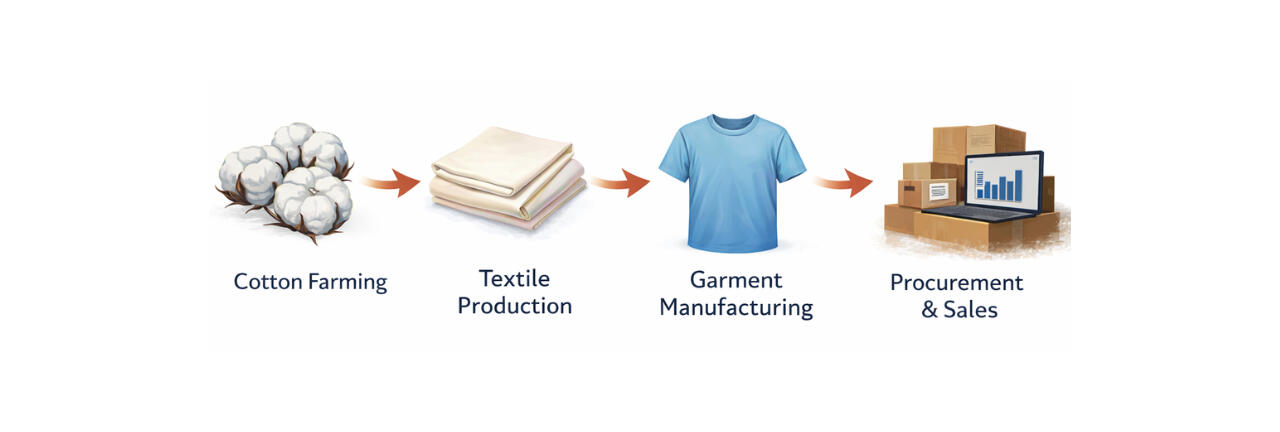
End-To-End Coordination

Phase 2: Value Chain Enablement
Nigeria’s FTA industry is being rebuilt on a new foundation that combines sound policy with strong institutions. During this phase, the policy and regulatory environment that supports the industry is strengthened.

Nomenclature Change – From CTG to FTA
The shift from Cotton, Textile and Garment (CTG) to Fibre, Textile and Apparel (FTA) reflects a broader vision.
Revised FTA Policy
The new policy framework will strengthen the value chain through raw materials, infrastructure, finance, fiscal, market, skill and regulation measures.
National FTA Development Council (NFTADC)
The soon-to-be operationalized NFTADC, will be a dedicated institution responsible for coordination & implementation


Phase 3: Value Chain Scale-Up
With pilots completed and enabling systems in place, the programme enters an expansion phase.Production capacity and utilization across cotton, textile, and garment segments grow as financing, infrastructure, and supply chain coordination support scale.

Value Chain Linkage
Connecting existing value chain actors and improving supply chain coordination
Textile Industrial Park
Revitalising dormant textile manufacturing assets and transforming them into CTG industrial parks
MSME Production Cluster
Strengthening MSME segment by upgrading textile and garment clusters


Phase 4: Market Expansion and Investment Anchoring
As production strengthens, the programme shifts to market depth and long-term investment.Domestic demand is expanded through structured market linkages, while regional opportunities open new pathways for Nigerian manufacturers. Investment frameworks are aligned to attract capital into cotton, textile, and garment production.
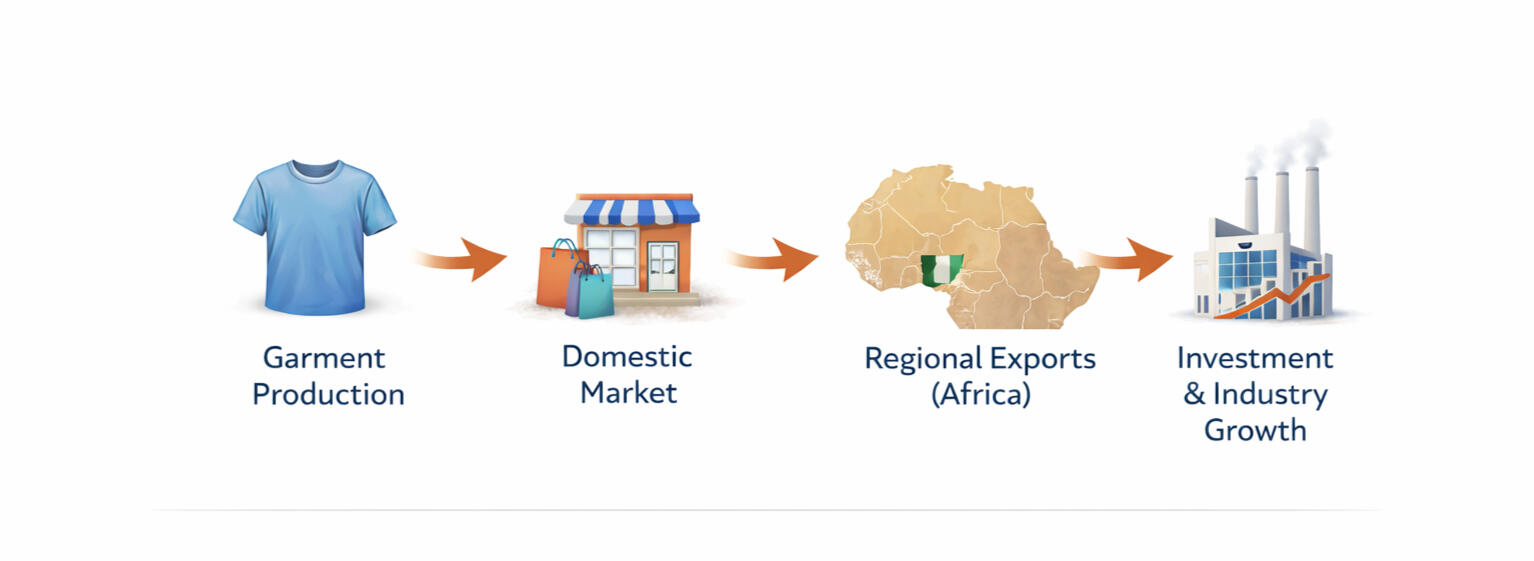
From Domestic to Export Growth

Programme Governance Structure
The NCTG-ITP is governed through a two-tier structure comprising the Strategic Coordination Body and the Implementation Task Force, with members drawn from government, financial institutions, development partners, and industry actors.


Looking Ahead ->

Earlier this year, we launched the Nigeria Industrial Policy (NIP), setting out a clear framework for strengthening Nigeria’s industrial base. Within this broader industrialization agenda, the FTA industry has been identified as a strategic sector with the potential to drive inclusive industrial growth.Reviving this sector is more than an economic imperative. It is central to job creation, rural development, and Nigeria’s participation in regional and global value chains. Through collaboration between government, industry, financial institutions, and development partners, we have established a clear growth pathway through the National Cotton, Textile and Garment Industrial Transformation Programme (NCTG-ITP).The next phase focuses on translating the programme into measurable outcomes: factories reopened, production capacity expanded, industrial clusters upgraded, and exports scaled.The goal is clear: to build a self-sustaining, globally competitive fibre-to-fashion economy that creates jobs, drives exports, and restores Nigeria’s place as a textile and apparel manufacturing leader in Africa.Senator John Owan Enoh
Honorable Minister of State for Industry
Federal Ministry of Industry, Trade, and Investment
Be Part of Nigeria’s FTA Transformation
Nigeria’s Fibre, Textile and Apparel (FTA) transformation is a national effort powered by collaboration. We invite investors, manufacturers, development partners, and entrepreneurs to play a role in building our fibre-to-fashion economy.
© All rights reserved.